
I thought Mum might tell me a happy story when I asked about her childhood. She remembered a house on a hill, the road beside it and the cars going past. Her mother stood there crying, and Mum remembered watching her.
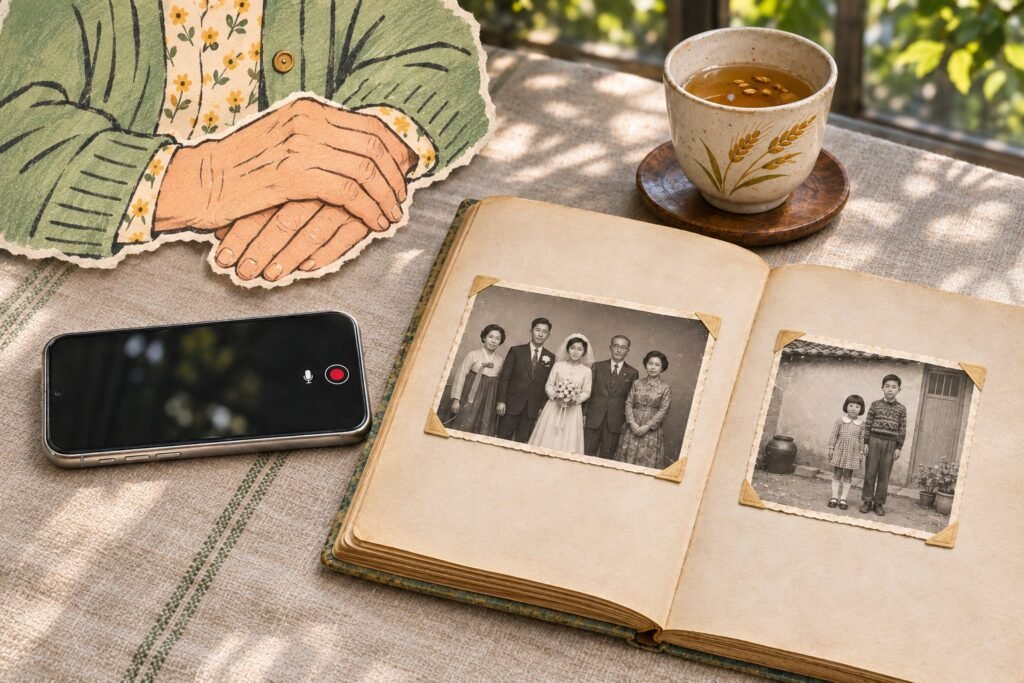
Mum was born in 1945. The Korean War began in 1950. Listening to her describe that road helped me picture the world she grew up in.
This guide is for grandparents, parents, great-aunts, anyone whose story you want to keep. I’ve learned it from recording my mother, and from years in aged care, where the best conversations often happen when no one is trying too hard.
Last week I shared 52 questions to ask your parents. I’m asking Mum one a week. If you’re wondering how to begin with someone in your family, here’s how I’d go about it.
Step 1: Ask permission, and explain why
Don’t surprise them with a recording. Say it plainly:
“I’d love to hear more about your life and keep it for the kids. Can I record us talking? Just on my phone.”
Some people say no at first. That’s fine. Talk without recording a few times. Often they’ll say yes later, once they see it’s just a chat.
Tell them what you’ll do with it: keep it in the family, make a little book, share it at a birthday. People open up more when they know where their words will go.
Step 2: Choose the right time and place
- Their place, not yours. Familiar surroundings bring back memories.
- Their best time of day. For many older people, that’s late morning. Avoid the end of the day, when they’re tired.
- Short sessions. 20 to 40 minutes is plenty. You can always come back.
- Quiet. Turn off the TV and radio. Background noise ruins recordings more than anything else.
If your grandparent lives in aged care, ask staff about a quiet room and a good time. Mornings after breakfast are often calmer.
Step 3: Prepare five questions, not fifty
The biggest mistake is a long list. It turns a conversation into a test.
Pick one theme per session (childhood, the war years, how they met, their first job) and five questions inside it. Start easy and concrete:
- What’s the very earliest thing you remember?
- Draw me the house you grew up in. Where was your favourite spot?
- What games did you play as a child?
- Of everything you ate as a child, what was the most special?
- Which teacher do you still remember?
You’ll find all 52 of my questions, grouped by season, in this post, and 10 of them as free printable cards. Cards are wonderful here. Let your grandparent pick one from the pile, and suddenly they’re in charge.
Step 4: Bring something to hold
Memories need a doorway. Bring:
- An old photo album
- A recipe card in their handwriting
- An object from their past: a medal, a sewing tin, a hymn book
- Music from when they were twenty
Ask “Tell me about this” instead of “Tell me about your life.” It’s much easier to answer.
Step 5: Record simply
You don’t need special equipment.
- Use your phone’s voice memo app. It’s good enough. Put the phone flat on the table between you, about an arm’s length away, screen down so it’s not distracting.
- Do a 10-second test first. Play it back. Can you hear both of you clearly?
- Turn on aeroplane mode so calls don’t interrupt (check your recorder still works first).
- Say the date and who’s speaking at the start. “It’s Sunday the 15th of November, I’m with Grandma at her house.” Future you will be grateful.
- Video is optional. Audio feels less exposing for many older people, and their voice is the treasure.
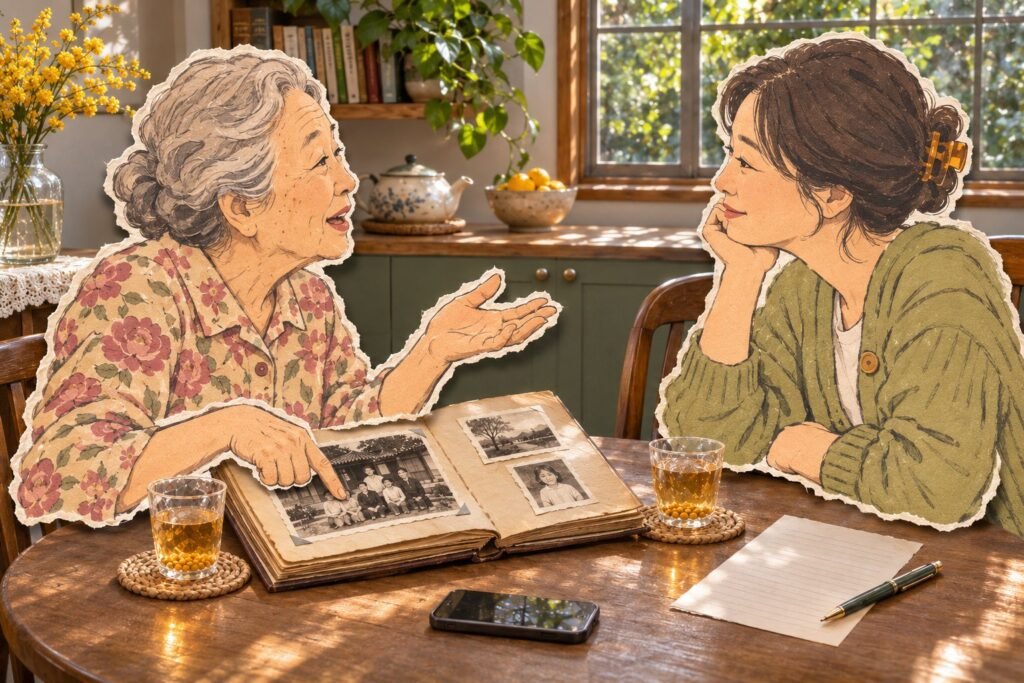
If they live far away
Mum and I used KakaoTalk for our video call. Before we started recording, I told her I wanted to share her story online. “Yes, that’s fine,” she said. Then she asked, “Can I do it looking like this? I should put on some lipstick and wear something nice.”
I’d only just woken up and looked a bit rumpled myself. I left her phone at the angle she had it. Next time, I’d like to give her a few minutes to get ready and help her find an angle she likes. I want to use the footage in a film about her life.
- Tell them before you press record, every time. With their permission, make a short test recording and play it back together to check that both voices came through.
- Use headphones with a mic so your voice doesn’t echo over theirs.
- Ask them to sit near a window, facing the light, with the TV off.
- Check your phone storage first. Video eats space fast.
Step 6: Listen more than you talk
I’d ask Mum one question and get what felt like several answers. One story would lead her into another, and I found it hard to interrupt her to ask the next question. In the end I let her carry on. That’s how we talk anyway.
- Use “And then?” and “What was that like?” Short follow-ups keep stories going.
- Let silence sit. Count to five before you speak. The best details often come after a pause.
- Don’t correct dates or facts. If the story differs from what you’ve heard, ask, “Oh, I thought it was Busan. Tell me again?” with curiosity, not correction.
- Ask for the senses. “What did it smell like?” “What were you wearing?” Sensory details bring stories to life.
- Let them speak their first language. If Grandma tells it best in Greek, Italian, Vietnamese or Korean, let her. You can translate later. I’ll share how to do that with AI tools in a later guide.
Step 7: Know when to stop
Stop when:
- They seem tired, repeat themselves, or lose the thread
- A memory brings real distress, not just tears
- They say “That’s enough for today”
Just saying the word “Mum” made my mother choke up. I wanted to picture the house on the hill exactly as she remembered it, but I couldn’t bring myself to ask her for more. If you’re unsure what someone wants, you can ask gently, “Would you like to keep going, or shall we leave it there for today?”
If your grandparent has dementia, keep sessions very short, focus on early memories (which often stay longer), and never test them with “Do you remember…?” Say “I heard that you…” instead.
Step 8: After the interview
- Thank them, and tell them one thing you loved hearing. It makes the next session easier.
- Back up the recording the same day. Email it to yourself, or save it to cloud storage. Phones get lost.
- Name the file clearly: 2026-11-15_Grandma_childhood.m4a
- Write three lines of notes while it’s fresh: the best story, a name to look up, a question for next time.
- Share a small piece with the family. One story, one photo. It shows your grandparent their life matters to people.
The interview is the gift
After we finished recording, I asked Mum if she’d ask me a question this time. It felt a bit awkward for her to be the one asking. She thought I’d just asked her another question and was about to answer it herself.
On your next visit or call, try one question. See where it takes you.
If you’d like help starting, download the 10 free Two Old Friends cards and bring them to your next visit.
With love, Esther