
When I first came to Australia, I cleaned houses for a living. One afternoon I walked into a home where guests were expected later that day. There was a big vase of yellow roses in the living room. Out in the backyard, small vases held two stems each.
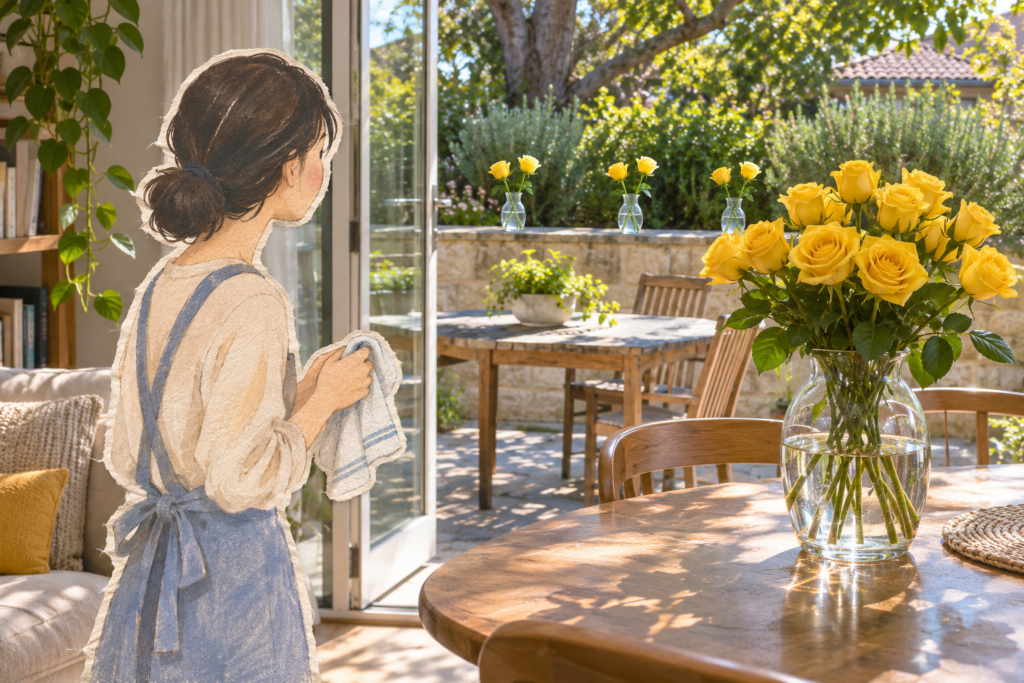
My English was poor then, and the British accent in that house was hard for me to follow. I heard the family talking about the plan for the afternoon. I thought I heard the word “funeral.” I assumed they were all going out to one.
The flowers were so bright and pretty that I tried to be friendly. “Who’s coming? What party is it?”
“Funeral.”
I asked “Pardon?” more than once. I don’t think a word has ever sounded so strange to me. When it finally landed, I said sorry, sorry, so sorry, and started rambling about how we do things in Korea. Then I asked who had died.
“My friend,” the woman said.
Why yellow roses?
A friend. I’d been trying so hard to understand the word funeral that I hadn’t even thought about who might be hosting it. In Korea, I’d always seen the family receive the guests. Here was a woman getting her backyard ready for a friend.
Then came another surprise. The woman looked to be in her late forties, maybe early fifties. Her friend had been in her seventies, and had died of cancer. Friends, with twenty-odd years between them. A farewell held by someone who wasn’t family. At home. Like a party.
And the flowers. Not white chrysanthemums, the flower of every Korean funeral I had ever known. Yellow roses, because they had been her friend’s favourite.
I didn’t stay for the gathering. But I remember standing in that bright room, not knowing how much sadness I was supposed to wear, or whether this was even a sad day at all.
Laughter in the church
Years later I began working in residential aged care. I have been with many people at the end of their lives since 2018. Yet I’ve been to only a few funerals here.
The ones I went to were called a service, the same word Australians use for a Sunday church service. One was held at the church the man had attended. People who remembered him stood up and spoke about him. Some read what they had written. And when someone told a funny story about him, the whole room laughed together. Laughter, at a funeral.
That was my second shock. In Australia, people often call this a celebration of life. At that service, I could hear how much people missed him and how funny he must have been.
Three days and nights in our house
In Korea, I grew up with something very different.
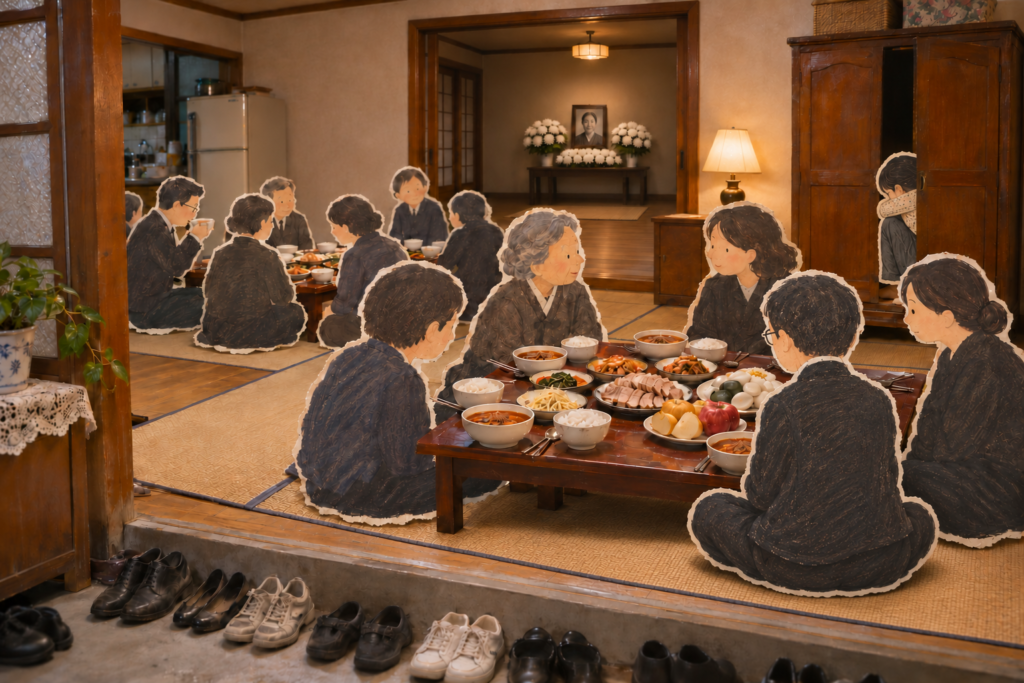
When my grandmother, my father’s mother, died, her funeral was held in our home. Many families did it that way then. It was a three-day funeral, as is traditional in Korea.
Everything moved quickly. Our church had a group that helped families at times like this. They ordered the food and helped receive the guests. The menu at a Korean funeral is almost always the same: beef soup, white rice, side dishes, rice cakes, fruit, slices of pressed pork, drinks, and soju. Honestly, it isn’t so different from the food at a wedding feast.
For three days and three nights, our house was packed with people. In a separate room, white chrysanthemums surrounded my grandmother’s portrait. I was twelve. I could hardly sleep. I crawled into the wardrobe because I wanted to get away from everyone and rest for a while.
When the coffin finally left for the burial ground, I cried until I couldn’t breathe. It was the first time I saw my father cry so hard.
“A person dies once, not twice”
My father died suddenly, during the pandemic. I was here in Perth, and quarantine rules meant I couldn’t fly home. I wasn’t the only one. All over the world, people were saying goodbye through screens.
In Korea, funeral halls are usually run inside or beside hospitals. My father was in a hospital in Busan, but he had lived in Jinhae. My brother quickly booked a funeral hall in Jinhae, so it would be easier for people to come, and moved him there.
We asked the hall if they could stream the ceremony where Dad was laid in his coffin, and the service that followed. It had never been done there. The staff were flustered, and of course they said no. “Maybe next time,” they said.
Next time? A person dies once, not twice.
So my brother video-called me now and then. Through his phone, I thanked the relatives, the cousins I hadn’t seen in years, the people who had been close to Dad. Mum sent me a photo of his portrait surrounded by flowers. I was too afraid to keep it, so I didn’t save it. I think his death still didn’t feel real.
What struck me most on those calls was the noise. Faces on the screen looked less sad than glad, glad to be together after so long. My brother told me Mum had been crying non-stop, but once the guests came she started to eat again and found a little strength.
People kept saying the same thing, and Koreans never forget to say it at a funeral:
“Thanks to him, we get to see each other.”
Our relatives, at Dad’s funeral
That is the Korean funeral to me. A funeral that keeps the living alive. A place to share grief and comfort one another.
When there is no one left to call
Within five years of Dad’s funeral, my husband’s uncle by marriage died. There was no funeral at all. His wife has four siblings, and they have three children. Still, the family said they felt bad asking people to come.
Mum says there are too many funerals these days. She’s still busy going to them. In Korea, we give buuigeum (부의금) at funerals. Each of us gives a little money to help the family with the cost. When someone who came to Dad’s funeral loses a loved one, Mum goes and gives buuigeum in turn. That’s the kind of give-and-take we call pumasi (품앗이). So many people came when Dad died. Mum still has a lot of kindness to repay.
Burial customs are changing, too. In 2024, South Korea’s cremation rate reached 94 per cent, according to The Korea Times.
Planning a celebration of life in Western Australia
If your family is considering a celebration of life, here is what I’d keep in mind.
- You don’t need a funeral director for the gathering. The WA Government says funeral directors “are not compulsory,” though most families use one for the cremation or burial and the paperwork.
- It can come later. Many families gather weeks after the cremation, once the ashes are home.
- Hold it where they belonged. A church, a park, the beach, a club, or the backyard.
- Let a friend lead, and make room for stories. A celebrant is optional. Ask three or four people for a short memory each. Funny stories are often the ones people remember.
- Choose their colours, not black. Their favourite flower, music, or footy colours. If someone can’t travel, as I couldn’t for my father, a video call lets them be there.
What a goodbye is for
In that Australian church, I heard a whole room laugh at a story about the man who had died. At Dad’s funeral, I heard the noise of a room full of relatives through my brother’s phone. I couldn’t be there with Mum, but I could hear the people who were.
When no one comes, I worry the person who died becomes even lonelier. A portrait among flowers holds a whole life, but it cannot tell the funny story that made a church full of people laugh.
That is why I record my mother now, one question a week. If you’d like to begin, try these 52 questions to ask your parents or my guide on how to interview a grandparent.
Tip: Ask your parent this week: “What flower would you want at your goodbye, and why?” Write down the answer, and the story that comes with it.
Your family’s goodbye doesn’t have to be white chrysanthemums or yellow roses. It just has to sound like them.
With love, Esther
Sources
- Choosing a funeral director, WA Government
- Cremation rate nears 95%, The Korea Times