
Week 01 · Rooster & Rabbit
This week’s card
What’s the very earliest thing you remember?
This year, my mum and I are sitting down together with one question a week. I ask her, then she asks me. We call it Two Old Friends, because that is what we are slowly becoming.
I thought asking for my mother’s earliest memory would be a gentle way to start.
Mum was quiet for a moment. There was too much, she said, and it was all tangled together. Then she began to tell me about a hill.
Mum’s answer
My mother’s earliest memory
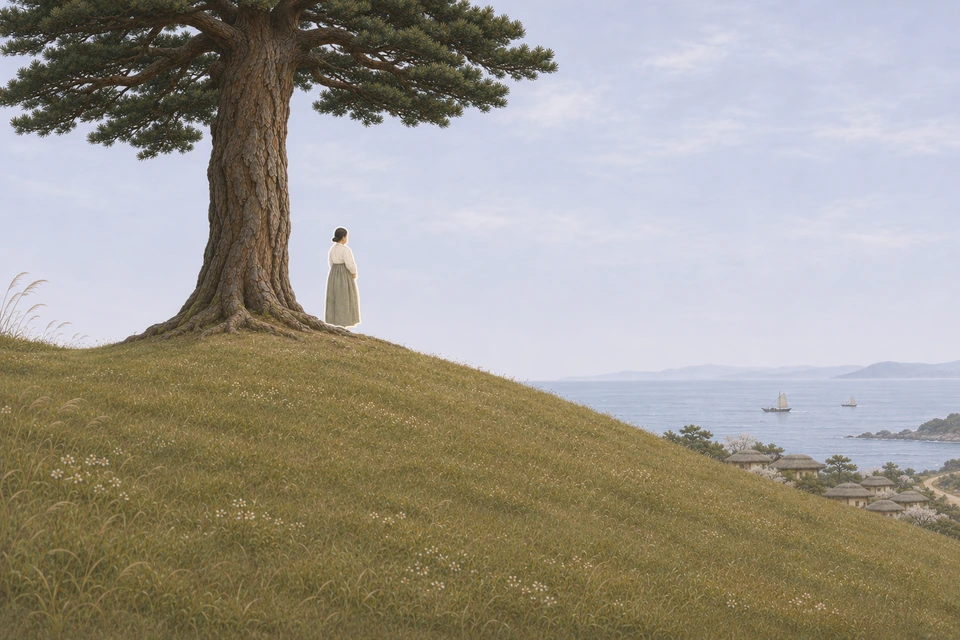
The hill in my mother’s earliest memory
Mum grew up in Jukbyeon, a harbour town in Uljin on Korea’s east coast. The family had a big house with a bamboo grove behind it. From the hill, the sea lay off to the left. Great old pine trees stood up there, and from beside them you could see the cars going down the road.
When the Korean War came, one of Mum’s brothers went away to the army. Every day, my mum’s mother went up to watch that road.
I keep thinking how small my grandma must have looked beside those pines. Someone passing below might only have seen a woman standing there. I wonder if anyone knew she was crying. Her little girl did.
“That is what I saw most, growing up. My mother crying. My mother always working.”
Mum
Grandma had nine children. Three survived. Of the brothers and sisters Mum lost, two are especially clear in her memory. One was a brother who died in high school. He was handsome, clever and gentle, the only son who worked alongside their mother to help her. I wonder if he was her favourite. She had seen him nearly grown.
The other was Mum’s youngest sister. She was seven, still in kindergarten. There had been measles in the family, and there had been fevers. We don’t know what all those fevers were.
“When I think of my childhood, there’s so much sadness. Always.”
Remembering their mothers
Even now, when the weather turns grey, Mum thinks of her mother. Once, sitting beside my dad, she began to sniffle. Soon she was crying so hard she couldn’t stop. Dad gave her a telling-off. A grown woman, crying like that.
I think about the boy Dad had been. His mother was over forty when she had him, her youngest child and only son. The year Dad started middle school, his father died. His mum was a small, gentle woman, and Dad remembered her crying so much that he could hardly bear the sound of crying after that.
It was a sharp thing to say to Mum. Still, there they were, sitting beside each other all those years later, each remembering a mother who cried.
Under her mother’s skirt
During the war, when the firing started, the men were often already away from the house. Mum’s mother had to get the children to the air-raid shelter uphill. She was pregnant. Mum held her little brother’s hand. Sometimes the firing went on from morning into the next day.
Her brother was quick and could always find somewhere to hide. “I was the problem,” Mum said. “I couldn’t walk fast.”
One day the guns out at sea began firing before they reached the shelter. My grandma lifted her skirt, pressed the two children down against a ridge in the rice fields and lay over them until the firing stopped.
All these years later, what Mum remembers from under that skirt is the warmth of her mother’s body and the roundness of her belly. There were two children underneath her and another inside.
“When I think about it, the tears just come,” Mum said. “With a baby inside her. With two of us.”
Then they got up and kept walking.
The little girl in Mum’s earliest memory
There is another little girl in these stories whom I’m still getting to know. When vaccinations were given at school after the war, Mum remembers the needle being heated over a flame. She was in about her first year of school. She ran off and hid in the toilet.
“Now I can prick my own finger,” she said. “Back then, if someone even said they’d do it, I’d start whimpering the day before.”
I’ve been her daughter for fifty years. I know the woman who raised me and became a grandmother to my girls. I’d never pictured her hiding in a school toilet, hoping nobody would find her.
The pumpkins under the porch
When Mum was small, she had whooping cough and measles, one after the other. The grown-ups thought she might die. There were gaps around the paper doors where you could peep out and see daylight. Her mother wouldn’t let her put so much as her nose near one, for fear of the draught.
While the other children could go outside, Mum sat beside her mother and helped with whatever her small hands could manage. Her mother worked and told her stories. They had hours together like that.
And there were pumpkins. Huge, ripe Korean pumpkins, stacked in the corners of the house, out the back and under the raised wooden porch where you took off your shoes. There were enough to last the winter. You could steam them, make a side dish or cook them down into porridge. When Mum was ill, pumpkin was about all she could manage to eat.
“I think I lived because I ate pumpkin,” she said.
Mum is in her eighties now and still gives those pumpkins credit. When she tells me about them, I think of her mother, who lost so many of her children. I picture the little girl beside her, too ill to go out, but willing to eat a little pumpkin. And here is that little girl, sitting with me, telling me about it.
My answer
Same question, my turn
What’s the very earliest thing you remember?
My earliest memory
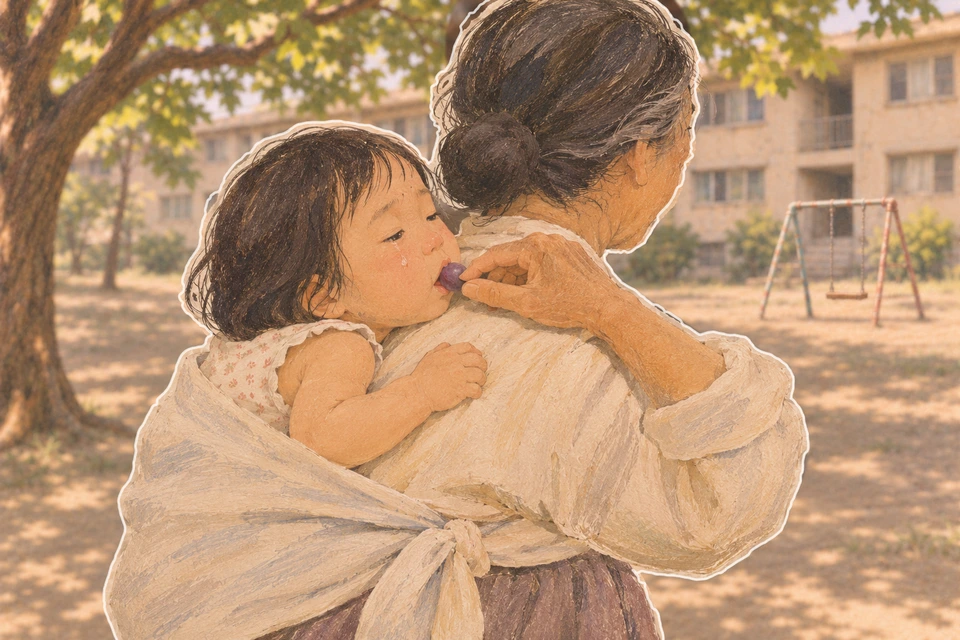
The warmth of her back
Then it was Mum’s turn to ask me. What was the very earliest thing I remembered?
A back. Her mother’s back.
I think my grandma had come to stay with us. Mum had to go to work, and I cried when I couldn’t keep her from going. What I remember is pressing my face, still wet with tears, into my grandma’s warm back. It was a hot summer. In my memory she carried me through the whole of it.
I wouldn’t eat my meal. Grapes, though, I would take.
The grapes I buy here in Australia have thin skins, and I eat them whole. The purple grapes I remember from Korea had thick skins. You put one to your lips and sucked. The green flesh slipped into your mouth and the skin stayed behind.
My grandma would reach back over her shoulder with a grape. There I was, the child who had cried for her mum and wouldn’t eat, still riding on her back. Pop. I took it. Then she passed me another.
What my other grandma kept for me
My dad’s mother lived with us in the navy apartment complex. When it was nearly time to eat, Mum would send me to fetch her.
I knew where to go. The senior centre was a little building shaped like a hanok, a traditional Korean house. I’d slide the door open and there would be my other grandma, somewhere in all that cigarette smoke.
She had taken up smoking after her husband died young. Much later, when she started going to church, she gave it up.
What fascinated me as a child was the thin silver foil inside her cigarette packets. She saved it and rolled it around and around. By the time I remember seeing it, the ball was as big as a Korean pear.
Someone had always brought food to the senior centre. A few rice cakes, something to nibble on. Grandma would wrap a little in her handkerchief, and when I came for her she’d press it into my hand. “Here, eat it quickly.” She never once forgot.
When I told Mum about that handkerchief, she thought of the kitchen back in Jukbyeon. Relatives from both sides were always dropping in. Her mother cooked more than the household could eat because she expected there would be somebody to feed.
So did my mum.
Mandu and songpyeon
When I was little, Mum and I made mandu, Korean dumplings, and songpyeon, little half-moon rice cakes. There’s a saying that if you shape your songpyeon beautifully, you’ll have a beautiful daughter. Mum and I were both good with our hands. Ours came out pretty.
Then off I’d go, delivering them from door to door. “Mum, stop sending them out,” I said once. “There won’t be any left for us.”
I had a confession to make. On one of those trips I’d fallen on the apartment stairs. The songpyeon went everywhere. I was so afraid Mum would scold me that I picked them all up and delivered them anyway.
Whose door was it? Did they eat them? I still don’t know.
“That’s the first time I’ve heard that story,” Mum said.
One hill, one back
The house I visited as a child was different from the one Mum grew up in, but it stood nearby, on the same hill. I can picture the place she is telling me about. The land has since been sold and developed. Rows of apartment blocks stand there now. I don’t think I’ll ever be able to walk up to the spot where my grandma stood watching the road.
Now, when I picture her reaching over her shoulder with a grape, I think of Mum under her skirt in the rice field, close enough to feel the baby in her belly. Years apart, each of us was small enough for the same woman to cover with her body or carry on her back.
My mum remembers her mother’s tears. I remember her back.
Your turn
Ask someone you love, “What’s the very earliest thing you remember?” Give them a moment. Then let them ask you.
With love, Esther